
Academy · Mechanic · 8 min read
Films, waterborne paint and aluminium: what really lies beneath the bodywork
What films really protect, why waterborne paint lasts as long as the painter applying it, why aluminium is a different trade. And who repairs your car.
A premium used car is judged first of all by its bodywork: it is the first thing you see and the last thing you think of checking. Yet that is exactly where today’s most expensive surprises hide: films covering repaints, waterborne paint jobs done in a hurry, aluminium panels repaired as if they were steel. And body shops whose name nobody will ever tell you.
1. Factory paint, in numbers
An original paint finish is a layered system: e-coat, primer, basecoat and clearcoat. On a series car the total is typically around 100–130 microns, with differences of about ±25 microns from one spot to another; on some high-end cars it is thicker.
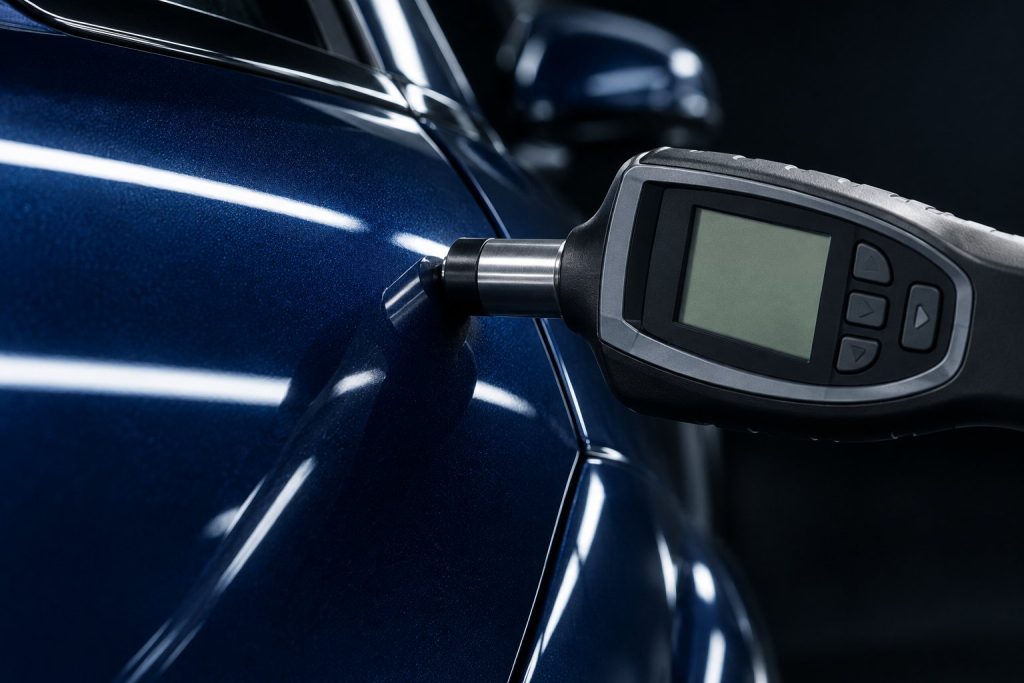
The tool that tells us is the paint thickness gauge. Two details make the difference between a serious measurement and a random number:
- The right probe. On steel you use a magnetic probe; on aluminium that probe measures nothing, you need an eddy-current probe. A cheap magnetic-only gauge sees nothing on an aluminium bonnet.
- The comparison. A repainted panel stands out because it is noticeably thicker than the panels next to it; where there is filler, readings easily exceed 300 microns. You measure near the edges of every panel and compare the values.
2. Protective films: what they do, what they don’t, what they hide
Clear paint protection films (PPF) are made of thermoplastic polyurethane. They are a serious product, but they need to be understood.
- What they do well. They soften small gravel chips and wash micro-scratches: the film takes the impact first.
- What they don’t do. A bigger stone or a branch scratching deep goes through it: the film then has to be replaced and the paint underneath often needs work anyway.
- How long they last. The best manufacturers offer warranties of up to 10 years, with limitations. In real life, sun, heat and washing make them yellow, dull or lift at the edges.
- Removal. On healthy factory paint, a good film comes off clean. An aged film easily leaves adhesive residue; on a poorly repainted panel, the film can take the clearcoat with it.
What matters if you are buying used. A film, and even more a colour wrap, prevents anyone from assessing the paint. The gauge measures film and paint together, and a repaint or damage under the film can be seen neither by eye nor with the instrument. A car that looks “perfect” under the film may really be perfect. Or not: without removing it, nobody knows.
3. Waterborne paint: the problem isn’t the water
Since 2007, European Directive 2004/42/EC has limited solvents in vehicle refinishing products: for topcoats the limit is 420 grams of volatile organic compounds per litre. That is why today the basecoat is almost always waterborne, while the clearcoat remains a solvent-based two-component product.
Does waterborne paint last less? No, if it is applied properly. Resistance to weather and scratches comes mainly from the clearcoat, and some studies even find waterborne basecoats less brittle. The problem lies elsewhere: water is far more demanding to apply than solvent.
- It dries with air, not just heat. It needs a booth with adequate, uniform airflow, with temperature and humidity under control.
- It does not forgive dirt. Compressed air free of oil, clean filters, demineralised water for reducing.
- It fears the cold. The product must be kept from freezing; once frozen, it goes in the bin.
- Few coats, difficult blending. Blending colour into an adjacent panel takes a skilled hand and experience.
When a waterborne paint job goes dull, peels or changes tone after a couple of years, the paint is almost never to blame: it is an inadequate booth or a step skipped to finish sooner. The painter makes the difference, not the tin.
4. Aluminium: a different trade
Premium brands use more and more aluminium for bonnets, doors, wings and, on some models, almost the whole body: it weighs less. Repairing it is nothing like repairing steel.
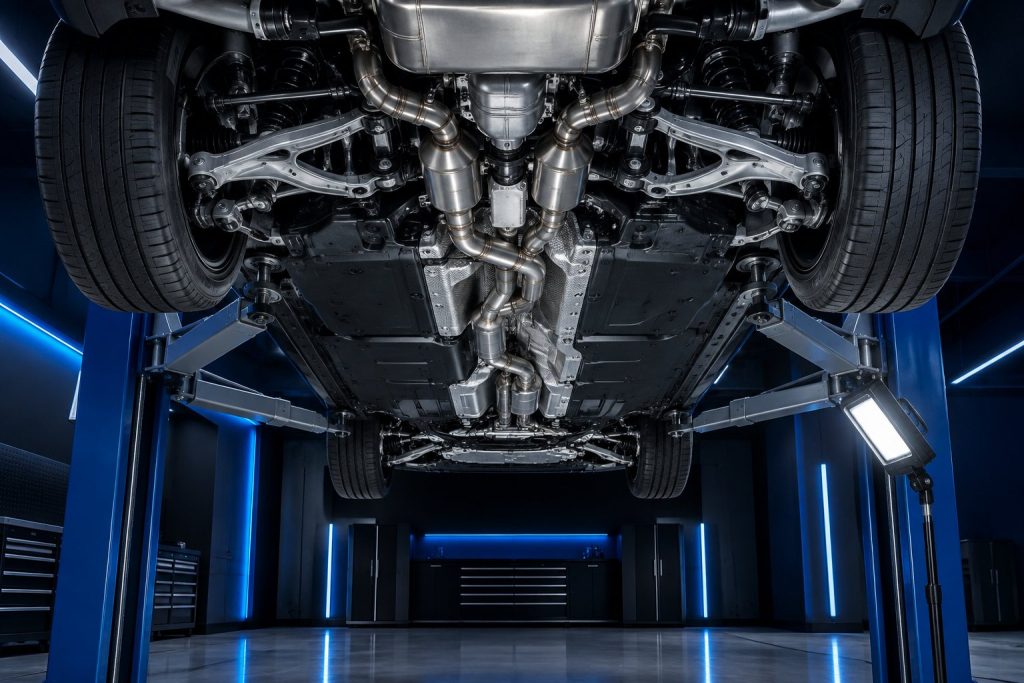
- Never together with steel. Steel particles landing on aluminium trigger galvanic corrosion, sometimes quickly. It requires dedicated tools and abrasives and a separate area.
- The dust is dangerous. Aluminium dust is extremely fine, stays airborne for hours and can be explosive: it needs specific extraction, and no compressed air for cleaning.
- The oxide forms again at once. After sanding, adhesives, sealers and fillers must be applied within about an hour; otherwise you start again.
- Structural parts are not straightened. Many European manufacturers forbid straightening structural aluminium: the damaged part is replaced and joined with rivets, rivet-bonding or welding, exactly as the manufacturer’s procedure prescribes.
An aluminium car repaired with steel tools can look perfect on delivery day. The corrosion shows later.
5. Who repairs your car? The question nobody asks
Many dealers repair or “recondition” the cars they sell. By whom, how and where, you usually don’t know. For us it is a central question.
- We only work with qualified partner body shops. Before entrusting any job, we verify through a quality audit that they have laminar-flow paint booths, proper measuring instruments, dedicated tools and areas for aluminium, quality paint products and trained staff.
- We monitor them over time. The result is checked on every job: a shop that doesn’t keep the standard gets no more work.
- No dirt yards. If a body shop works in the open, strips cars in the street or lacks the right instruments, we entrust it with nothing: the result would be different, and sooner or later it would show.
- We measure and we write it down. Paint thickness is measured panel by panel, before and after, and goes into the technical dossier. We assess the paint bare: no films or wraps covering what lies beneath.
A car that looks good in photos is not enough. What counts is what gets measured, who worked on it, and what stays in writing.
Sources
- Directive 2004/42/EC, Annex II B
- US EPA, Auto Refinishing: Waterborne Basecoats (2008)
- FenderBender, Why Go Waterborne?
- 3M, Aluminum Hygiene
- Repairer Driven News (2017)
- FenderBender, Understanding aluminum structural repairs (2015)
- DeFelsko, Automotive paint inspection
- Detailed Image, Paint measurements
- Motor1, Is paint protection film worth it?